
The house is quiet at five in the morning. The kids are asleep, the coffee is doing its slow work, and the loudest thing in the room is the refrigerator. It is an ordinary, unremarkable kind of safety — the kind you stop noticing the moment you have it. And while I stand at my kitchen window, somewhere a sailor is standing a midwatch on a dark sea, an airman is on a cold flight line, a soldier is awake at a post with a name I will never learn. I get to not think about them. That is more or less the point of what they do. It is also the thing I want to stop and actually think about.
We are told, constantly, that the authentic life is the one turned inward. Be true to yourself. Follow your heart. Protect your peace. The word “authentic” has come to mean a life curved back toward its own wants. But if you go looking in Scripture, you find the exact opposite claim — and you find it, oddly enough, standing next to the men and women in uniform.
Bible verses for soldiers start in a strange place
If you go searching for Bible verses for soldiers, you might expect swords and armies and the courage to fight. Those are in there. But the verse that sits underneath all of it — the one that explains why a life of service looks the way it does — has no battlefield in it at all:
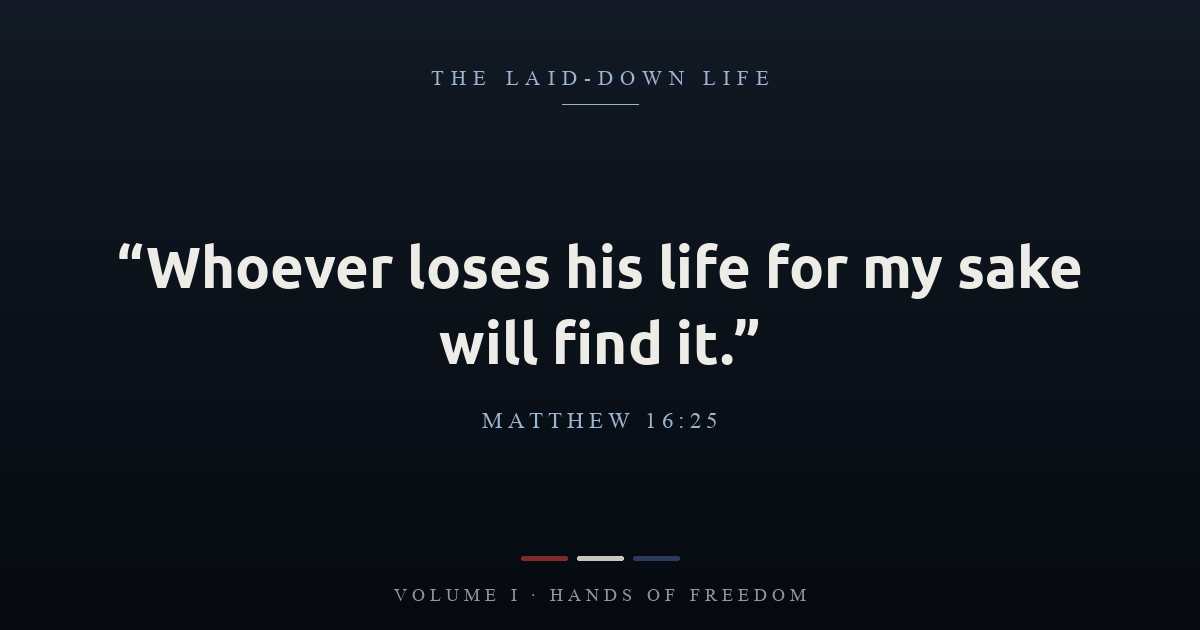
“Whoever wants to save his life will lose it, but whoever loses his life for my sake will find it.”
Matthew 16:25
That is the whole thing, right there. The culture says you find your life by keeping it. Jesus says you find it by laying it down. And the service member — whatever else is true of them, whatever mix of reasons put them in that uniform — is a living picture of exactly that trade. A laid-down life. Poured out daily, mostly unseen, for people who love them and people who never will.
The hands and feet
On the last night before he laid his own life down, Jesus got up from supper, wrapped a towel around his waist, and washed his friends’ feet — the job of the lowest servant in the house. Then he said this:
“I have set you an example that you should do as I have done for you.”
John 13:15
Here is where I have to be careful, because it would be easy to say something untrue and flattering. The military does not save anyone. It does not heal anyone. Freedom, in the deepest sense, and healing, and peace with God — those come from one place, and it is not a uniform. God is the source. But a service member is, in a specific and costly way, a set of hands and feet. They carry people toward safety they cannot themselves manufacture. They stand between the ordinary morning and the thing that would ruin it. They do the low, unglamorous, foot-washing work of keeping someone else’s life quiet enough to be taken for granted. Instruments, not the source. Hands and feet.
Poured out, mostly unseen
We picture service as the dramatic moment — the charge, the rescue, the medal. But almost none of it looks like that. Most of it is the watch nobody thanks you for. The birthday missed over a video call that keeps freezing. The training done again because it was not yet good enough. The long boredom of being ready for something you hope never comes. Scripture keeps blessing precisely this kind of hidden faithfulness: “Whatever you do, work at it with all your heart, as working for the Lord” (Colossians 3:23), and the promise that the Father “who sees what is done in secret” is the one keeping the account (Matthew 6:4). Most of the laid-down life is laid down where no camera is running.
For friends — and for strangers
There is a sentence Jesus said that has been carved on more war memorials than any other, and for good reason:
“Greater love has no one than this: to lay down one’s life for one’s friends.”
John 15:13
We will come back to that verse across this whole series, because it is the hinge everything turns on. But notice what service stretches it toward. The person standing the watch is not only laying their life down for their friends — the ones back home they love. They are doing it for a whole country of strangers, including plenty who will never agree with them, thank them, or think of them at all. That is the point where honoring a soldier stops being ordinary patriotism and starts looking uncomfortably like the gospel itself: love poured out for people who did nothing to earn it.
And here is the strange part, the part that tells you the picture is real: say any of this to an actual service member and most of them will wave it off. “I was just doing my job.” “The real heroes didn’t come home.” They are, almost to a person, deeply uncomfortable being praised for it. That flinch is not false modesty. It is the same instinct that runs through the whole laid-down life — the ones who most embody it are the least interested in being seen doing it. Their discomfort with this article is part of what makes the article true.
One honest note before we go on
I am writing this as a grateful civilian, on the outside of a world I have not lived in. I will get things wrong, and I would rather own the outside vantage than fake the inside one. One small thing I can get right, and that this series will try to get right throughout: the names. Soldiers are Army. Sailors are Navy. Airmen, Marines, coast guardsmen, guardians — each branch has its own word, earned and particular, and “service members” is the honest word for all of them together. Getting the name right is a small, cheap way of actually paying attention to a person instead of a symbol. It is the least the rest of us can do.
The pattern, and the One it points to
If I am honest, I have laid down very little. Most of my days are spent saving my life, not spending it — keeping my comfort, my schedule, my peace. Sitting with the laid-down life of a service member does not mainly make me proud. It convicts me, gently, and then it points me somewhere. Because every laid-down life is an echo. The country’s freedom rests on people who poured themselves out for it; and behind every one of those sacrifices, casting the shadow they all fall inside of, is the One who laid his life down completely and for everyone — and then picked it up again on the third day. That is where this series is going, in the end. Every hand and foot points back to his.
So this is a tribute, and it has nothing to sell you. It asks only three things: pray for the men and women standing the watch tonight, learn their right names, and honor the pattern by living a little more poured-out yourself. What they have already laid down is the whole point. This is the first piece in an ongoing series — The Laid-Down Life — honoring the people whose ordinary, hidden faithfulness buys the quiet the rest of us wake up inside of.
0 Comments